Updated
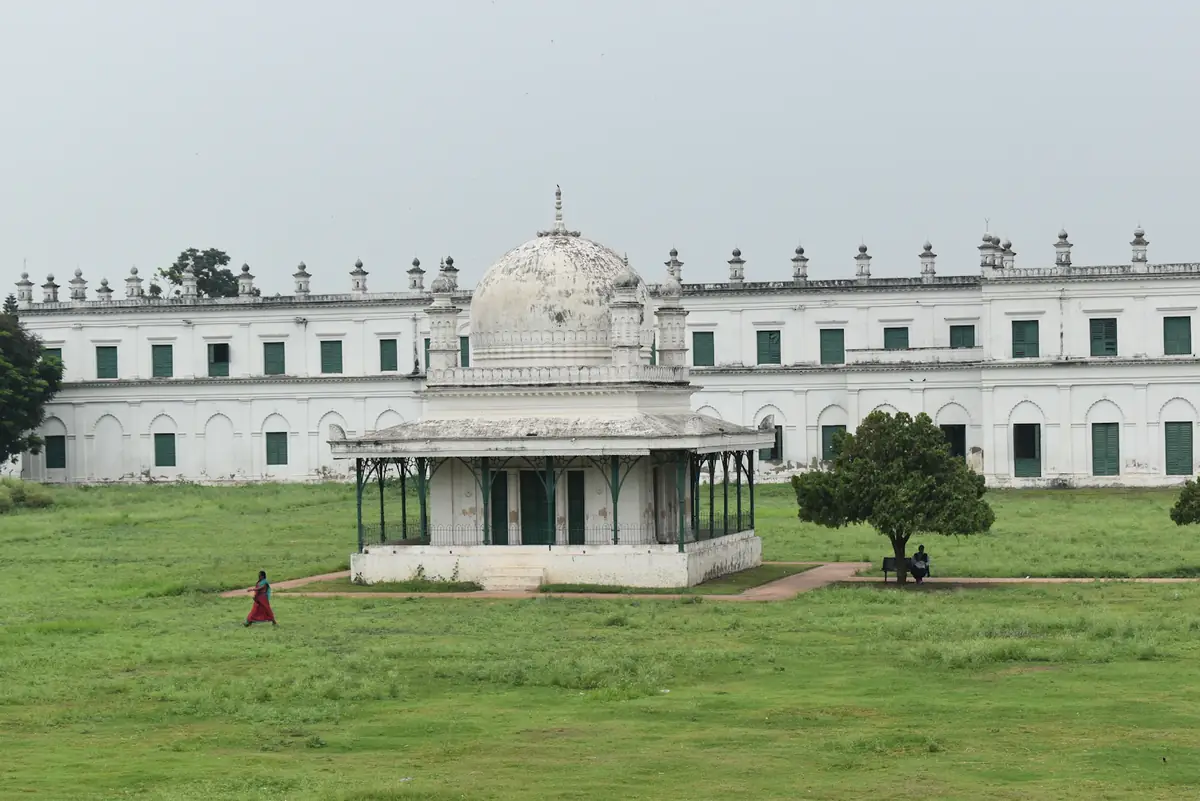
Murshidabad district is the land of the last Nawabs of Bengal. In 1704 Murshid Quli Khan renamed a town on the Bhagirathi after himself and made it the capital of the Mughal province of Bengal, and for half a century it was one of the richest courts in India. Its fall began at Plassey in 1757 and the capital moved to Calcutta, but palaces, mosques, garden tombs and the mansions of the bankers and merchants who served the court still line the river between Lalbagh, Jiaganj-Azimganj and Cossimbazar.
The Bhagirathi runs north to south through the middle of the district and splits it into two nearly equal halves: higher, rolling country to the west and low, fertile land to the east. To the east the district borders Bangladesh, and at Farakka in the north a barrage diverts water from the Ganga into the Bhagirathi. Berhampore (Baharampur) is the headquarters and the usual base for visitors.
History here goes back well before the Nawabs. Karnasubarna, south-west of Berhampore, was the 7th-century capital of King Shashanka, and the Shakti Peetha at Kiriteswari is often called the oldest temple in the district. The Jain Sheherwali families of Azimganj and Jiaganj, the Roy family's palace at Cossimbazar and Rani Bhabani's terracotta temples at Baranagar add other layers.
How to reach Murshidabad district
By train. Two lines from Kolkata run through the district: the Sealdah–Ranaghat–Krishnanagar–Lalgola line, with stations at Berhampore Court and Murshidabad, and the Howrah–Katwa–Azimganj line, with stations at Khagraghat Road and Azimganj. A branch links Azimganj with Nalhati. Check current trains with Indian Railways.
By road. NH 12 runs north–south through the district, past Berhampore, linking it with Kolkata and with Malda and north Bengal. State buses connect Berhampore with Kolkata and the district towns.
By air. The nearest major airport is Kolkata (CCU). Getting around the Lalbagh sights is easiest by toto, tonga or hired car, and ferries cross the Bhagirathi to Khushbagh and Baranagar.
Best time to visit
October to March is the most comfortable season for walking between monuments; summers are very hot and the monsoon brings heavy rain from June to September. Durga Puja is celebrated across the district, and at old family houses such as Cossimbazar Rajbari it is still held in the family courtyard. Muharram is the time to see the Nizamat Imambara in use, and the Paush fair at Kiriteswari falls in midwinter.
Silk and crafts
Murshidabad silk is the district's best-known product, and the Baluchari sari takes its name from Baluchar, the old name of Jiaganj, although the weaving later moved to Bishnupur. The district also has a tradition of ivory and wood carving, sholapith work and bell-metal and brass ware, made especially around Khagra in Berhampore, Kandi, Baranagar and Jangipur.
Sightseeing guides in Murshidabad
- Hazarduari PalaceMurshidabad
- Nizamat ImambaraMurshidabad
- Katra MasjidMurshidabad
- KhushbaghMurshidabad
- MotijheelMurshidabad
- Kathgola PalaceMurshidabad
- Nashipur RajbariMurshidabad
- House of Jagat SethMurshidabad
- Jafarganj CemeteryMurshidabad
- Cossimbazar RajbariMurshidabad
- Char Bangla Temples, BaranagarMurshidabad
Murshidabad district: questions
How many days do I need for Murshidabad?
Two full days cover the main Lalbagh sights, Khushbagh, Kathgola and Nashipur. Add a day for Azimganj, Baranagar and Kiriteswari, or for Cossimbazar and Karnasubarna near Berhampore.
Where should I stay to visit Murshidabad?
Most visitors stay in Berhampore, the district town, about 20 to 25 minutes from the Hazarduari area. There are also hotels in Lalbagh, a heritage stay at Cossimbazar Rajbari and homestays at Kiriteswari.
Why was Murshidabad the capital of Bengal?
Murshid Quli Khan, the Mughal governor, moved the capital here and renamed the town after himself in 1704. It stayed the Nawabs' seat until the British moved the capital to Calcutta after Plassey.
Is the Plassey battlefield in Murshidabad district?
No. Palashi (Plassey), where the battle was fought in 1757, is in neighbouring Nadia district, to the south.
Sources
- Murshidabad district (Wikipedia)
- Murshidabad district tourist places (official site)
- Palashi (Wikipedia)
- Baharampur (Wikipedia)
- West Bengal heritage trail in Murshidabad (Outlook Traveller)
- Cossimbazar Rajbari: the rise of the phoenix (Outlook Traveller)
- Kiriteswari Temple (Wikipedia)
- Karnasubarna (Wikipedia)