Updated
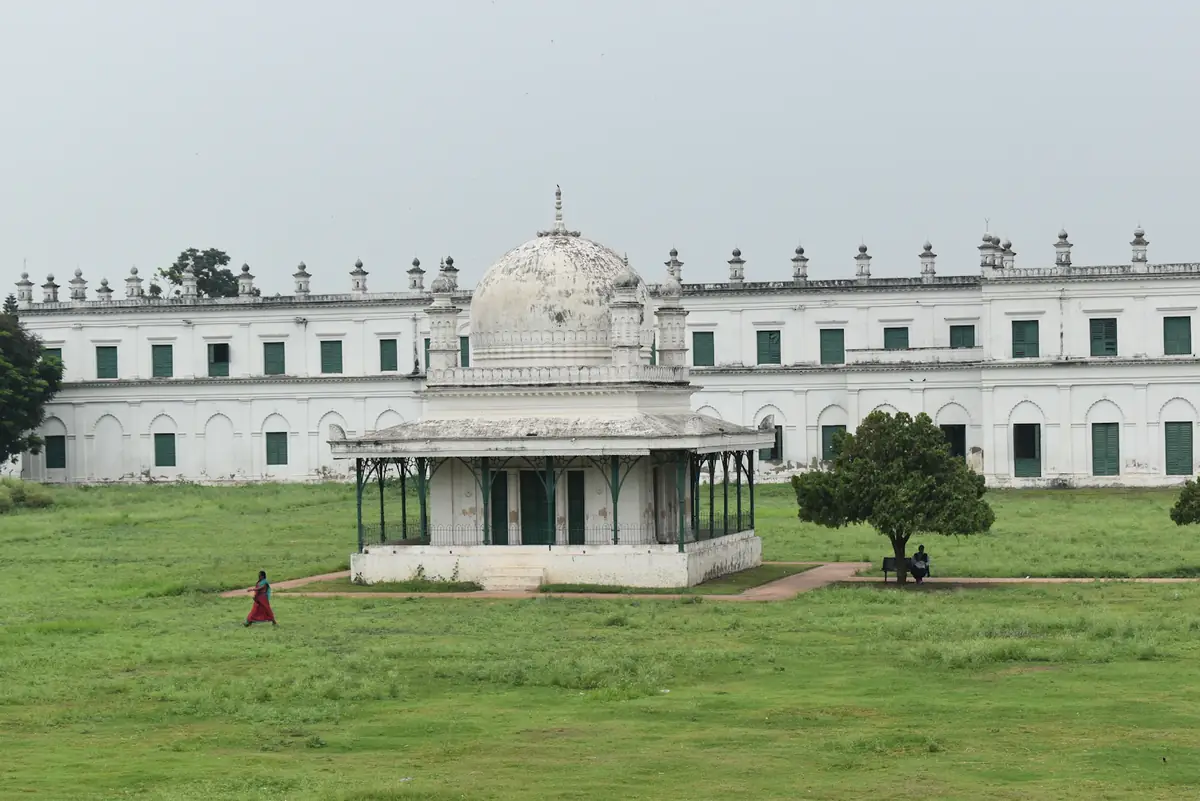
Jiaganj and Azimganj are twin towns facing each other across the Bhagirathi, a short way upriver from Murshidabad: Jiaganj on the east bank and Azimganj on the west. They are famous as the home of the Sheherwalis, Oswal Jain merchant and banking families from Rajasthan who settled here in the 18th century, and for the cluster of Jain temples and grand family mansions they left behind. A ferry across the river links the two, and Rani Bhabani's terracotta temples at Baranagar are close to Azimganj.
Things to do in Jiaganj–Azimganj
Neminath Temple, Azimganj
Founded in 1887 and dedicated to the 22nd tirthankara, it is the central temple of Azimganj's Jain community. A cupboard in the temple holds a library of handwritten Jain texts, mostly from the 19th and 20th centuries.
Chintamani Parshwanath and other temples
Azimganj's Jain quarter has a group of about seven temples, including Chintamani Parshwanath and Sambhavanath; others such as Sanwalia Parshwanath and a dadabadi stand at Rambagh.
Jain temples of Jiaganj
On the east bank stand temples to Sambhavanath, Vimalnath and Adinath, among others; one Adinath temple stands in the grounds of the Kathgola garden palace.
Bari Kothi, Azimganj
The Dudhoria family's ancestral mansion, built in the early 18th century, with Greek, Roman and French influences in its architecture. It has been restored and now takes guests as a heritage hotel.
The Jiaganj–Azimganj ferry
A municipal boat crosses the Bhagirathi between the two towns, with open views of both banks.
Baranagar temples
Near Azimganj, at Baranagar, Rani Bhabani of Natore built terracotta temples in the 18th century, including the Char Bangla group.
The Sheherwalis
In 1717 Murshid Quli Khan made Murshidabad the capital of Bengal. In the course of the 18th century Oswal Jain families from Rajasthan, who settled in Azimganj and Jiaganj and made fortunes in banking and the textile trade, later becoming zamindars. Their name is usually explained as 'those who go to the city' (sheher), because the men travelled to Murshidabad, the city, on business.
The most famous of these families were the Jagat Seths, bankers to the Nawabs and later to the East India Company, whose old family house near Murshidabad is now a museum. As the British moved power to Kolkata, many Sheherwali families followed, but they kept their temples and houses here and some have restored them in recent years.
Sheherwali cooking is Jain vegetarian food from Rajasthan adapted to Bengal: it uses panch phoron, the Bangla five-spice mix, alongside the rose water, saffron and dry fruits of Nawabi cooking.
Baluchar and the towns' later history
Jiaganj's old name was Baluchar. The Baluchari sari, a silk sari with woven scenes from the epics, takes its name from Baluchar and was first made in the Murshidabad area in the 18th century; today it is woven at Bishnupur. Jiaganj's Sripat Singh College was founded in 1949 with support from a local Jain zamindar.
How to reach Jiaganj and Azimganj
By train. Azimganj Junction and Azimganj City are on the west bank, and Jiaganj station on the east bank. Trains from Kolkata include services to Jiaganj and through Azimganj towards Malda; check current timings with Indian Railways.
By road. Roads connect Jiaganj with Lalbagh (Murshidabad town), Berhampore, Lalgola and Bhagabangola. A rail bridge between Nashipur and Azimganj has been under construction.
Getting around. Cross between the towns by the municipal ferry. Murshidabad's Hazarduari Palace and the Kathgola gardens are a short drive from Jiaganj.
Jiaganj–Azimganj: travel questions
What is Jiaganj–Azimganj famous for?
Jiaganj and Azimganj are twin towns facing each other across the Bhagirathi, a short way upriver from Murshidabad: Jiaganj on the east bank and Azimganj on the west. They are famous as the home of the Sheherwalis, Oswal Jain merchant and banking families from Rajasthan who settled here in the 18th century, and for the cluster of Jain temples and grand family mansions they left behind.
What is the best time to visit Jiaganj–Azimganj?
The best time to visit Jiaganj–Azimganj is October to March.
How far is Jiaganj–Azimganj from Kolkata?
Jiaganj–Azimganj is about 215 km from Kolkata by road, about 5.5 hours by car depending on traffic.
How do I reach Jiaganj–Azimganj?
By air: the nearest airport is Netaji Subhas Chandra Bose International Airport (CCU), Kolkata, about 5–6 hours by road. By train: Azimganj Junction, Azimganj City or Jiaganj. By road: about 215 km from Kolkata.
What are the places to visit near Jiaganj–Azimganj?
Places near Jiaganj–Azimganj include Murshidabad (about 6 km), Kiriteswari (about 6 km), Berhampore (about 15 km) and Karnasubarna (about 25 km). Distances are in a straight line.
Who are the Sheherwalis of Azimganj?
Oswal Jain merchant and banking families from Rajasthan who settled in Azimganj and Jiaganj in the 18th century, when Murshidabad was the capital of Bengal.
How many Jain temples are there in Azimganj and Jiaganj?
Azimganj has a cluster of about seven Jain temples; counts for the whole Murshidabad, Azimganj and Jiaganj area are about 13 or 14.
Which side of the river is Azimganj on?
Azimganj is on the west bank of the Bhagirathi and Jiaganj on the east bank, the same side as Murshidabad town.
Can you stay at Bari Kothi?
Yes. The Dudhoria family's mansion in Azimganj has been restored and operates as a heritage hotel; check current availability directly.
Is Jiaganj the origin of the Baluchari sari?
Jiaganj's old name was Baluchar, and the Baluchari sari is named after it. The sari is now woven mainly at Bishnupur in Bankura district.