Updated
Purba Bardhaman is the flat, fertile rice country between the Damodar, the Ajay and the Bhagirathi, once described in British records as the richest tract in Bengal. It was created on 7 April 2017, when the old Bardhaman district was divided in two, and its headquarters is the historic city of Bardhaman. The name is linked by some historians with Mahavira Vardhamana, the 24th Jain tirthankara; in the Mughal period the area was part of Sarkar Sharifabad.
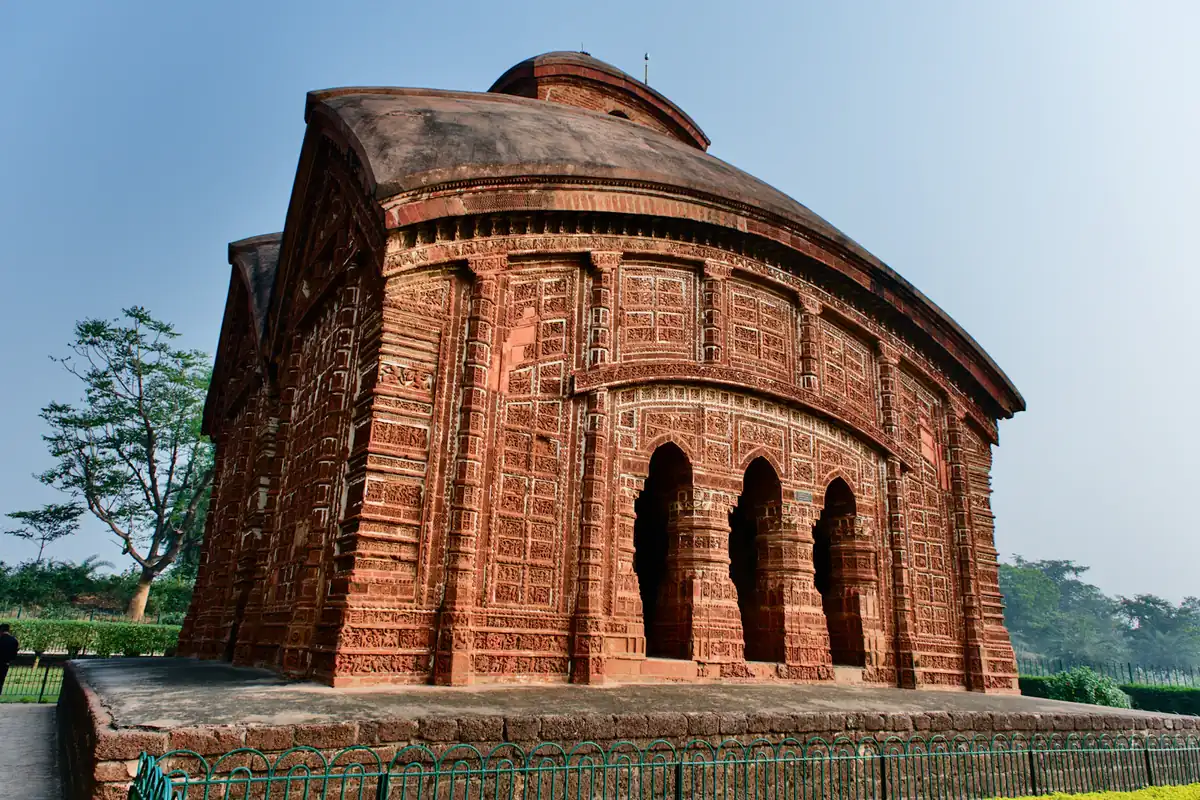
For visitors the district is above all the country of the Bardhaman Raj, the zamindari family that ruled a vast estate from the 17th century until 1955 and built temples across Bengal. Their legacy is everywhere: Curzon Gate, the Rajbari and the Sarbamangala temple in Bardhaman city, the 108 Shiva temples at Nawabhat, and above all the terracotta temples of Ambika Kalna on the Bhagirathi. Older history survives too, from the Mesolithic site of Pandu Rajar Dhibi in the Ajay valley to the Mughal-era tomb of Sher Afghan.
Along the Bhagirathi the district is also sacred to Vaishnavas: Katwa is where Chaitanya took sannyasa in 1510, and Kalna has temples from his lifetime onwards.
How to reach Purba Bardhaman
By train. Bardhaman Junction is one of the major railheads of the state, on the main Howrah–Delhi routes. The Bandel–Katwa line serves Kalna, Purbasthali and Katwa, and lines from Bardhaman run to Katwa. Check current timings with Indian Railways.
By road. The Grand Trunk Road route runs through Bardhaman city, and state buses connect the district with Kolkata and the rest of Paschim Banga.
By air. Kolkata (CCU) is the nearest international airport; Kazi Nazrul Islam Airport at Andal (RDP) has domestic flights.
Best time to visit
October to March is the best time. The climate is hot and humid: May is the hottest month and January the coldest, and the monsoon from June to September brings about three-quarters of the 1,400 mm annual rainfall. Kalbaisakhi thunderstorms are common from March until the monsoon. Durga Puja at Bardhaman's Sarbamangala temple and Kartik Larai at Katwa in November are the liveliest festival times.
Planning a visit
Bardhaman city is the natural base, with Curzon Gate, the Rajbari, Golapbag and the Sarbamangala temple all within a few kilometres. Kalna is an easy day trip by train from Kolkata or Bardhaman. Katwa, further up the Bhagirathi, suits travellers interested in Chaitanya and the Battle of Plassey.
Sightseeing guides in Purba Bardhaman
- 108 Shiva Temples, KalnaAmbika Kalna
- Kalna Rajbari Temple ComplexAmbika Kalna
- Curzon GateBardhaman
- Sarbamangala TempleBardhaman
- 108 Shiva Temple, NawabhatBardhaman
- Tomb of Sher AfghanBardhaman
- Bardhaman RajbariBardhaman
Purba Bardhaman district: questions
When was Purba Bardhaman district formed?
On 7 April 2017, when the old Bardhaman district was split into Purba (east) and Paschim (west) Bardhaman.
What is Purba Bardhaman famous for?
Its rice farming, the temples and palace of the Bardhaman Raj, the 108 Shiva temples of Kalna, and sweets such as mihidana and sitabhog from Bardhaman.
What is the headquarters of Purba Bardhaman?
Bardhaman (Burdwan) city. The district has four subdivisions: Bardhaman Sadar North, Bardhaman Sadar South, Kalna and Katwa.
Why is the district called Bardhaman?
Some historians link the name to Mahavira Vardhamana, the 24th Jain tirthankara; others read it as a prosperous, growing land.