Rajbari means royal house. Across Paschim Banga, maharajas, nawabs and wealthy zamindar families built palaces and mansions, many with their own temples, courtyards and thakur-dalans where Durga Puja is still held.
Some are museums run by the state or the ASI, some are family homes opened for festivals or stays, and some are slowly decaying. Check access before you go: opening days and rules vary.
Cooch Behar Palace
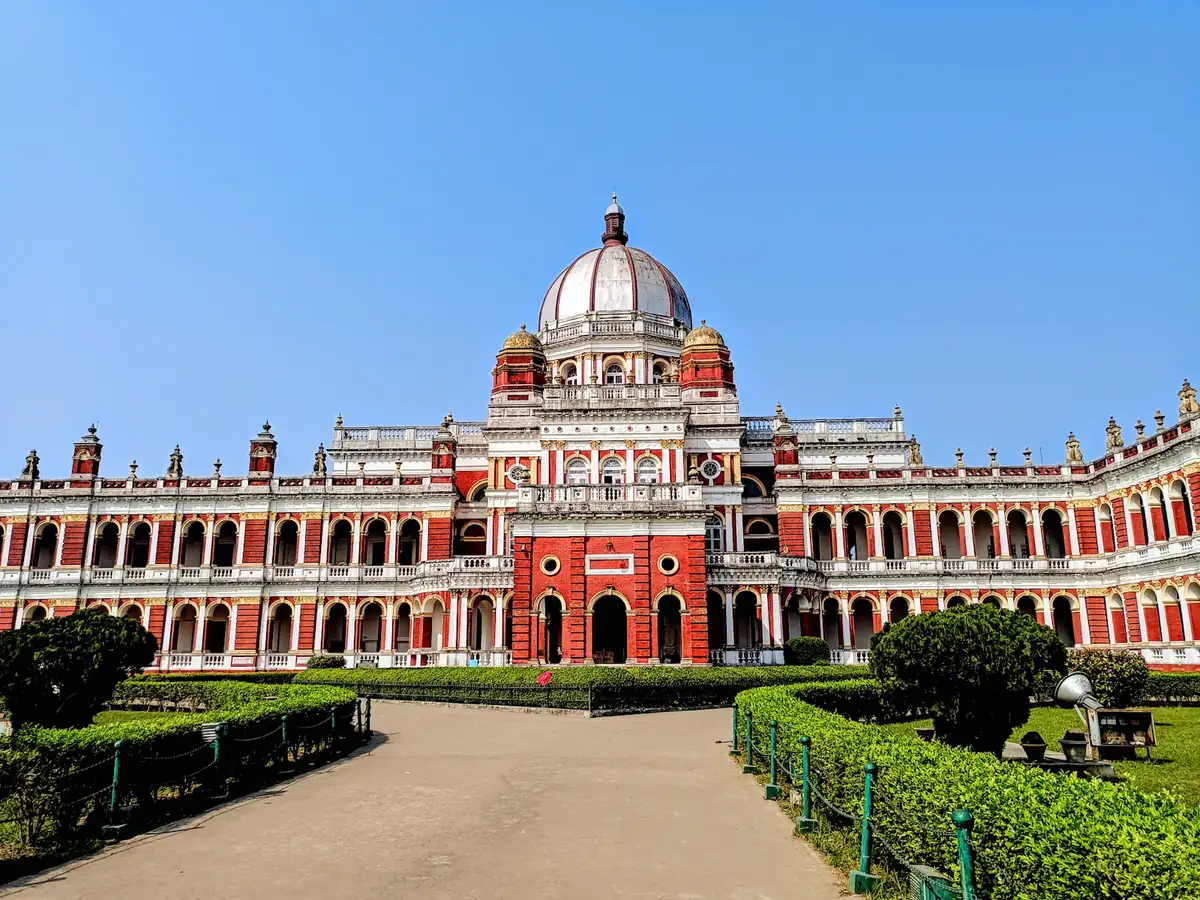
Cooch Behar Palace, known locally as the Rajbari, is the grandest building in North Bengal's old royal town. It was built in 1887 for Maharaja Nripendra Narayan of the Koch dynasty in the classical European style of the Italian Renaissance, and today it is a museum protected by the Archaeological Survey of India as a monument of national importance.
Hazarduari Palace
Hazarduari Palace is the best-known building in Murshidabad and the reason most visitors come. Its name means "a thousand doors": the palace is said to have about a thousand, a large share of them false.
Kathgola Palace
Kathgola Palace is a four-storey mansion set in large walled gardens on the northern side of Murshidabad, built in 1873 by the brothers Dhanpat Singh and Lakshmipat Singh Dugar, wealthy Jain merchants. The gardens also hold the Adinath temple, a Jain shrine to the first tirthankara.
Nashipur Rajbari
Nashipur Rajbari is the palace of the Nashipur Raj family in the village of Nashipur, just north of Murshidabad town. The family's fortunes go back to Debi Singha, who collected revenue for the East India Company in the years after Plassey.
Cossimbazar Rajbari
Cossimbazar Rajbari, the Palace of the Roys, stands in Cossimbazar, the old river port between Berhampore and Murshidabad. The Roy family grew rich in the silk trade in the 18th century, lost their income after zamindari was abolished, and from the 1990s restored the decaying palace.
Bardhaman Rajbari
The Rajbari, or Rajbati, is the palace of the Bardhaman Raj, one of the richest zamindari families in Bengal. Maharaja Mahtab Chand built it in the 19th century, and after the zamindari was abolished the last Maharaja, Uday Chand Mahtab, handed it to the state.
Jhargram Rajbari
Jhargram Rajbari is the palace of the Malla Deb family, the former rulers of Jhargram, set in lawns and gardens on the edge of the town. The present building was begun in 1922 and completed in 1931 under Raja Narasingha Malla Deb, and it is still the family's home.
Itachuna Rajbari
Itachuna Rajbari is a zamindar's mansion of 1766 in Itachuna village, Hooghly district, built by Safallya Narayan Kundu and still managed by his family. It is famous as a heritage homestay where guests sleep in rooms furnished with old furniture around a classic Bangla courtyard, and as a film location, most notably for the Hindi film Lootera (2013).
Jalpaiguri Rajbari
The Jalpaiguri Rajbari is the old palace of the Raikats, the rulers of Baikunthapur, in the Rajbari Para area of Jalpaiguri town. The family was a branch of the Koch royal house of Cooch Behar, and its Durga Puja, held at the Rajbari every autumn, is said to be more than five hundred years old.
Marble Palace
The Marble Palace is a 19th-century mansion on Muktaram Babu Street in north Kolkata, famous for its marble floors, walls and statues and for a crowded collection of European paintings, sculpture and furniture. It was built by Raja Rajendra Mullick, a wealthy merchant and collector, and is still the home of his descendants, who open part of it to visitors.
Sovabazar Rajbari
Sovabazar Rajbari is the 18th-century palace of Maharaja Nabakrishna Deb on Raja Nabakrishna Street in north Kolkata. It is best known for its family Durga Puja, traditionally said to have begun in 1757 to celebrate the British victory at Plassey, with Robert Clive among the guests.
Jorasanko Thakur Bari
Jorasanko Thakur Bari is the ancestral home of the Tagore family in north Kolkata, where Rabindranath Tagore was born in 1861 and where he died in 1941. The complex of mansions round a large courtyard now belongs to Rabindra Bharati University, and its main building houses the Rabindra Bharati Museum, devoted to the poet and to the family that played such a large part in the 19th-century Bengal Renaissance.