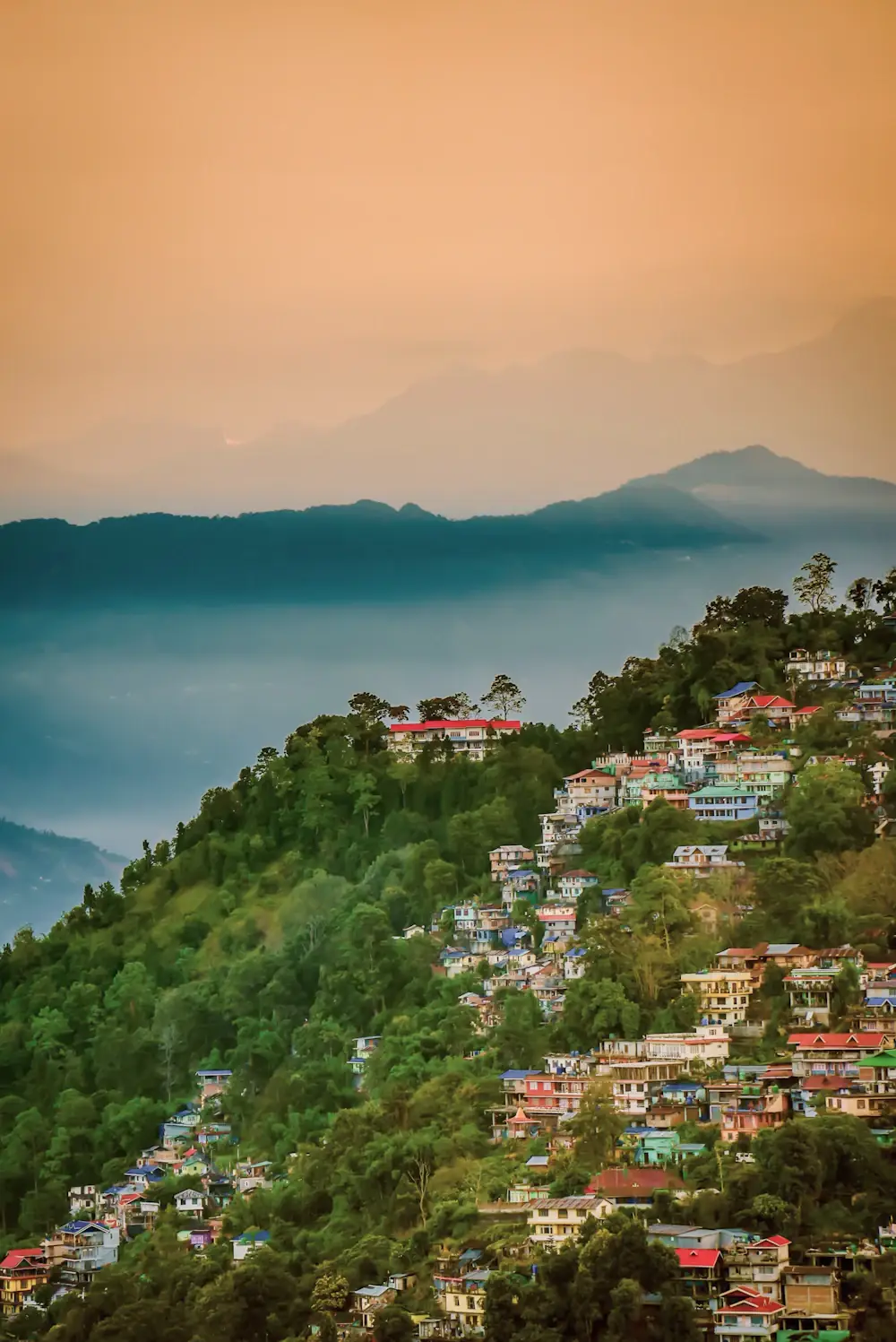
Tibetan Buddhism came to the Darjeeling and Kalimpong hills with traders, settlers and, after 1959, refugees from Tibet. Monasteries of several schools now stand on the ridges, from small village gompas to large teaching institutions.
Visitors are generally welcome outside prayer times. Walk clockwise around stupas and prayer wheels, remove shoes where asked, and ask before photographing monks or the inside of prayer halls.
Ghoom Monastery (Yiga Choeling)
Yiga Choeling, known to most visitors as the Ghoom Monastery or Old Ghoom Monastery, is a Tibetan Buddhist monastery of the Gelug order at Ghoom, on the ridge above Darjeeling. Founded in 1850, it is described as the first Tibetan Buddhist monastery built in the Darjeeling region.
Bhutia Busty Monastery
Bhutia Busty Monastery, also called Karma Dorjee Chyoling, stands in Bhutia Busty, about a mile from Observatory Hill in Darjeeling. Its roots go back to the monastery that once crowned Observatory Hill, the place from which Darjeeling is traditionally said to take its name, and it is one of the oldest Buddhist foundations in the town.
Dali Monastery (Druk Sangag Choling)
Dali Monastery, properly Druk Sangag Choling, stands on a hillock at Dali, on the road and railway between Darjeeling and Ghum at about 7,000 ft. Built in 1971, it belongs to the Drukpa branch of the Kagyu school of Tibetan Buddhism, and with about 200 resident monks it has the largest monastic community in the area.
Japanese Temple & Peace Pagoda
On the slopes of Jalapahar, a short drive from the centre of Darjeeling, stand two buildings of the Japanese Buddhist order Nipponzan Myohoji: a white two-storeyed temple in Japanese style, built in 1972, and beside it the Peace Pagoda, a tall white stupa opened in 1992. Visitors come for the calm, the views over the town and the rhythmic drumming of the temple prayers.
Zang Dhok Palri Phodang
Zang Dhok Palri Phodang, better known as the Durpin Monastery or Durpin Gompa, is the largest monastery in Kalimpong and the town's best-known Buddhist landmark. It stands on top of Durpin Hill at the south-western end of the Kalimpong ridge.
Tharpa Choling Monastery
Gaden Tharpa Choling is a Gelug monastery on Tirpai hill, on the road from Kalimpong town up to Dr Graham's Homes. It was founded by the Tibetan lama Domo Geshe Rinpoche Ngawang Kalsang at the request of Tibetan merchants and Bhutanese leaders living in Kalimpong, a reminder of the years when the town was the main market for the Tibet trade.
Thongsa Gompa
Thongsa (Tongsa) Gompa is the oldest monastery in Kalimpong and a survivor of the period, before 1865, when the hills east of the Teesta were ruled by Bhutan. The district administration's guide book says the exact year of construction is not on record, but that it was built by the Bhutanese in the last quarter of the 17th century, and many scholars place its completion in 1692.
Salugara Monastery
Salugara, about 6 km from the centre of Siliguri, is home to Tibetan Buddhist monasteries. Its best-known sight is a white stupa about 100 ft high, called the Great International Tashi Gomang Stupa, which is believed to have been built by the Tibetan teacher Kalu Rinpoche.
Sonada
Sonada is a small hill town on Hill Cart Road and the Darjeeling Himalayan Railway, about 16–17 km before Darjeeling and 16 km above Kurseong. It is known for its Tibetan Buddhist monastery, founded by the Tibetan teacher Kalu Rinpoche in 1965 and now the seat of the Shangpa Kagyu lineage, and for Salesian College, founded here in 1933.
Pedong
Pedong is a small ridge town east of Kalimpong, close to the Sikkim border, on the old trade route that climbed to Tibet over the Jelep La. It is known for the ruins of Damsang Fort, the Lepcha stronghold of the 17th century, for the old Sangchen Dorjee Monastery and for the Cross Hill raised by a French missionary in 1882.
Madhupur Dham (Madhupur Satra)
Madhupur Dham, or Madhupur Satra, is a Vaishnava monastery in Cooch Behar Sadar subdivision, honoured as the place associated with the last days of Srimanta Sankardev (1449–1568), the saint, poet and reformer of Assam. His chief disciple Madhavdev also died here, and the satra is one of the most important pilgrimage places in Paschim Banga for followers of Sankardev's Ekasarana tradition, many of whom come from Assam.