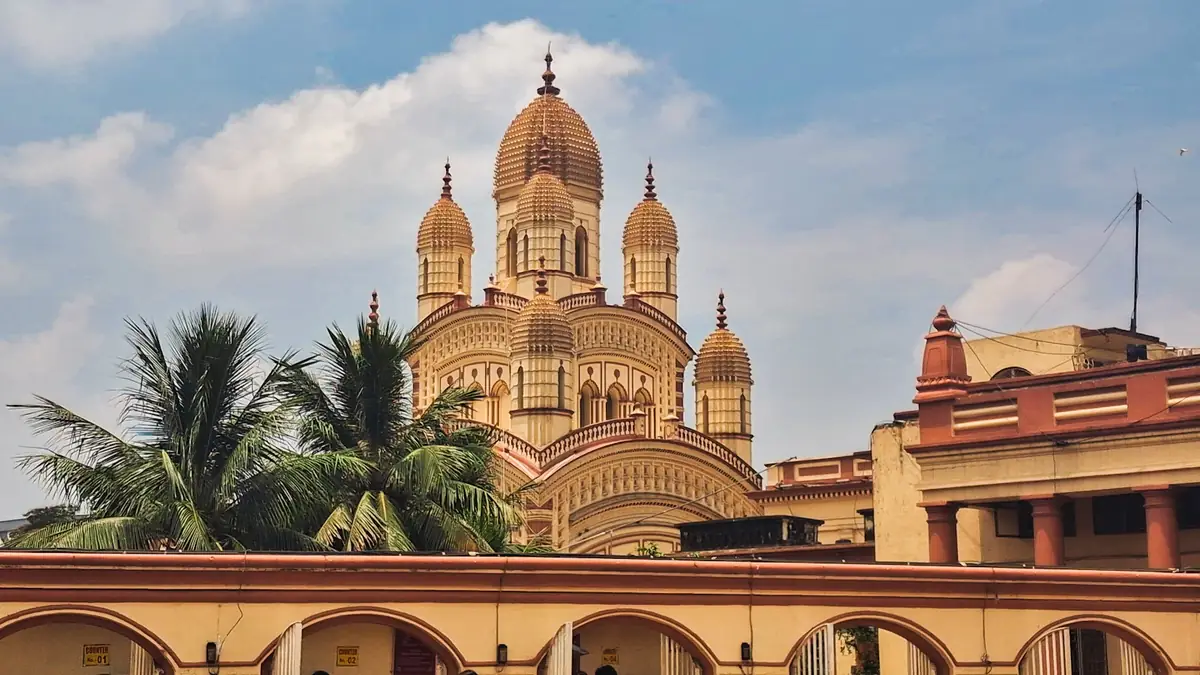
Plenty of Paschim Banga is within an easy day of Kolkata: the river towns of the Hooghly, the temples of Dakshineswar and Belur, old zamindar houses, archaeological sites and quiet riverside villages.
This list is sorted by driving distance from central Kolkata, computed on OpenStreetMap data. For many places on the Hooghly, the suburban train from Howrah or Sealdah is quicker than the road.
Barrackpore
Barrackpore, about 25 km north of Kolkata on the Hooghly, grew around the East India Company's first cantonment, set up in 1772, and was later the Governor-General's country retreat. It is famous as the place where the sepoy Mangal Pandey attacked his British officers on 29 March 1857, one of the first sparks of that year's uprising, and for Gandhi Ghat, where some of Mahatma Gandhi's ashes were immersed.
Budge Budge
Budge Budge is a river town on the east bank of the Hooghly, at the south-western edge of the Kolkata metropolitan area. It is famous for the Komagata Maru incident of 29 September 1914, when police opened fire on returning Punjabi passengers of the ship Komagata Maru at the Budge Budge riverside, killing about 20 of them.
Serampore
For ninety years Serampore was Frederiknagore, a Danish trading town, until it was sold to Britain in 1845. It became a pioneering centre of printing and education, where William Carey's mission press and Serampore College changed publishing in Indian languages.
Achipur
On the bank of the Hooghly about 30 km south of Kolkata, Achipur is named after Tong Atchew, said to be the first Chinese settler in Bengal. Around 1778 he was granted land here for a sugar mill.
Bawali
Bawali is a small temple town in South 24 Parganas, close to the Hooghly south-west of Kolkata. It is famous for the Mondal family, zamindars since Mughal times, who filled the village with Krishna temples in the late 18th century, and for their two-storeyed mansion, the Rajbari Bawali, now restored as a heritage hotel.
Babur Haat
About 50 km from Kolkata, Babur Haat is a rural escape of bheris (fishing lakes), rice fields and mango groves.
Chandannagar
Chandannagar, once Chandernagore, was a French trading settlement on the Hooghly for more than two and a half centuries and joined India only in the early 1950s. It is famous for its riverside Strand, its French-era museum and church, and the Jagaddhatri Puja, when the town's light artists cover the streets in illuminations.
Chandraketugarh
Chandraketugarh is an archaeological site at Berachampa in North 24 Parganas, the remains of a city occupied from around the 3rd century BCE that was once a port in the Ganges delta. It is famous for its terracotta plaques and figurines, among the finest found in eastern India, and many historians link it to the Gangaridai, the delta people described by Greek and Roman writers.
Chinsurah & Bandel
Chinsurah (Chuchura), Hooghly and Bandel run together along the Hooghly about 45 km north of Kolkata, and each was shaped by a different trading power: the Portuguese at Bandel, the Dutch at Chinsurah, and Mughal-era and Shia merchants at Hooghly. They are famous for Bandel Church of 1599, the clock-towered Hooghly Imambara and the Dutch cemetery.
Falta
In 1756, after Nawab Siraj ud-Daulah captured Calcutta, East India Company officials took refuge at Falta. Today it is a quiet riverside spot where the Hooghly runs broad and tidal.
Antpur
Antpur is a village in Hooghly district known for two things: the Radhagovindajiu Temple of 1786, about 100 feet high and covered in terracotta, and its place in the story of the Ramakrishna order. On the night of 24 December 1886, Narendranath (later Swami Vivekananda) and eight other young disciples of Sri Ramakrishna sat round a sacred fire here and vowed to renounce the world.
Diamond Harbour
An easy day trip from Kolkata, Diamond Harbour sits on a broad bend of the Hooghly estuary, with fort ruins and a long riverside walk.
Halisahar
Halisahar is an old riverside town on the Hooghly in North 24 Parganas, best known as the ancestral home of Ramprasad Sen, the 18th-century poet-saint whose songs to Kali are still sung across the state. His house and sadhana site, the Ramprasad Bhita, draw devotees throughout the year.
Deulti & Samtaber
In the village of Samta, near Deulti, the novelist Sarat Chandra Chattopadhyay built a house on the banks of the Rupnarayan and wrote here for years. It is a peaceful day out from Kolkata.
Jaynagar Majilpur
Jaynagar Majilpur is a twin town on the old course of the Adi Ganga, south of Kolkata on the road and railway to the Sundarbans. It is famous across Paschim Banga for Jaynagarer moa, its celebrated sweet, and for a long history as a river settlement of zamindars, scholars and revolutionaries.
Canning
Canning is a market town on the west bank of the Matla river, the railhead for the Sundarbans and the seat of the Sundarban Tiger Reserve's head office. It is famous as Port Canning, an ambitious 1860s plan to build a deep-water port to rival Calcutta and Singapore, which was wrecked by a cyclone in 1867 and abandoned a few years later.
Raichak
Raichak is a stretch of the lower Hooghly where the river widens towards the sea, popular for weekend stays and river walks.
Bansberia
Bansberia is a small riverside town in Hooghly district best known for the Hangseshwari Temple, a five-storey shrine to the goddess crowned with thirteen lotus-bud spires, built between 1799 and 1814. In the same compound stands the Ananta Basudeba Temple of 1679, whose walls carry some of the finest terracotta in the state.
Chhatrabhog
Chhatrabhog is a village near Mathurapur in South 24 Parganas that was once a river port on the old course of the Ganges, the Adi Ganga. It is famous as the last place in the 24 Parganas where Chaitanya Mahaprabhu halted, in 1510, on his journey by boat to Puri, and for its temples of the goddess Tripura Sundari and of Shiva as Ambulinga, which local people regard as a Shakti pitha.
Tarakeswar
Tarakeswar is a pilgrimage town in Hooghly district built around the Taraknath Temple, one of the most important Shiva shrines in the state, where Shiva is worshipped as a self-manifested (swayambhu) linga. It is famous for the Shravan pilgrimage each July and August, when huge numbers of devotees in saffron walk here from the Hooghly carrying Ganga water to pour on the linga.
Tribeni
Tribeni is an ancient bathing place on the west bank of the Hooghly, named for the point where the Saraswati and the Jamuna were once said to branch off from the Ganga. It is best known for the mosque and tomb of Zafar Khan Ghazi, dated by inscription to 1298 and counted among the earliest surviving Muslim monuments in Bengal.
Taki
Taki stands on the Ichamati river, which forms the border with Bangladesh. It is best known for its Bijoya Dashami, when idols are immersed in the shared river.
Itachuna Rajbari
Itachuna Rajbari is a zamindar's mansion of 1766 in Itachuna village, Hooghly district, built by Safallya Narayan Kundu and still managed by his family. It is famous as a heritage homestay where guests sleep in rooms furnished with old furniture around a classic Bangla courtyard, and as a film location, most notably for the Hindi film Lootera (2013).
Radhanagar
Radhanagar is a village in the Khanakul I block of Hooghly district, famous as the birthplace of Raja Rammohan Roy, the reformer who campaigned against sati and founded the Brahmo Sabha. Visitors come to see the Rammohan Memorial Hall, completed in 1929 on the site of his father's house, along with the ruins of the house Rammohan built for himself and a mango grove planted by him and his father.
Tamluk
Tamluk is the headquarters of Purba Medinipur district and one of the oldest towns in Paschim Banga. It is famous as the probable site of Tamralipta, the great port of ancient Bengal from which ships sailed to Sri Lanka, Southeast Asia and China, visited by the Chinese pilgrims Faxian and Xuanzang.
Gadiara
Gadiara is a riverside village in the Shyampur I block of Howrah district, known for its wide view over the meeting of the Rupnarayan with the Hooghly, with the Damodar joining close by. It is famous for sunsets over the water and for the ruins of Fort Mornington, a British fort said to have been built by Robert Clive after the Battle of Plassey, which now shows only at low tide.
Jatar Deul
Jatar Deul is a tall brick temple tower standing alone in the fields near Raidighi, on the western fringe of the Sundarbans. It is famous as one of the very few early medieval monuments in the delta, usually dated to around the 10th–11th century, and as a puzzle: no image, cult or reliable inscription survives to say who built it or for which god.
Khirai
Khirai is a village in the Panskura block of Purba Medinipur, famous for the flower fields that stretch out beside its railway station and along the Kansabati river. The area, promoted locally as the Valley of Flowers, is part of the most productive flower-growing belt in Paschim Banga, supplying roses, marigolds, chrysanthemums, gladioli and tuberoses to Kolkata's markets.
Kakdwip
Kakdwip is the busy delta town where travellers catch the ferry to Sagar Island, and a fishing hub for the southern coast.
Phulia
Phulia is a weaving town in the Shantipur block of Nadia district, known for handloom saris woven in the Tangail tradition brought by weavers from Dhaka after Partition. It is also the birthplace of Krittibas Ojha, the 14th–15th-century poet whose Bangla Ramayana, the Krittivasi Ramayan, is the best-known Bangla telling of the epic.
Ambika Kalna
Ambika Kalna, usually just called Kalna, is a riverside town in Purba Bardhaman famous for its 108 Shiva temples, built in two concentric rings in 1809, and for the terracotta temples of the Rajbari complex opposite. Both were built by the Maharajas of Bardhaman and their queens in the 18th and 19th centuries, when the town was at its most prosperous.
Guptipara
Guptipara is a riverside village in the Balagarh block of Hooghly district, famous for the Brindabanchandra Math, a walled group of four Vaishnava temples from the 17th and 18th centuries with fine terracotta and murals. It is also remembered as the birthplace of the barowari, the community-funded Durga Puja, and for a Rath Yatra whose chariot travels further than almost any in India outside Puri.
Shantipur
Shantipur is an old town in the Ranaghat subdivision of Nadia, known across India for its handloom saris and for its Ras and Dol festivals. It has been a centre of Sanskrit learning for many centuries and is closely tied to Advaita Acharya, a senior companion of Chaitanya.
Bibhutibhushan Wildlife Sanctuary (Parmadan)
Bibhutibhushan Wildlife Sanctuary, long known as Parmadan Forest, is a small protected forest on the bank of the Ichamati in North 24 Parganas, about 25 km from Bangaon. It is best known for its herd of more than 200 spotted deer, descended from 14 chital released here in 1964, and for its riverside setting.
Kamarpukur
The village where Sri Ramakrishna was born in 1836 is now a calm pilgrimage centre run by the Ramakrishna Mission.
Moyna (Moynagarh)
Moyna is a village in the Tamluk subdivision of Purba Medinipur, famous for Moynagarh, the old fort of the Bahubalindra rajas, which stands on an island ringed by two wide moats. Inside the moats are the family's temples, including Lokeswar Shiva and Shyamsundar Jiu, and a Ras festival in late autumn, with a night-time procession by boat, has been held here since the 16th century.
Jayrambati
Jayrambati is the village where Sri Sarada Devi, Ramakrishna's spiritual companion, was born in 1853.
Mahishadal
Mahishadal is a small town in the Haldia subdivision of Purba Medinipur, famous for the Mahishadal Rajbari, the palace complex of the local zamindars, and for one of the oldest chariot festivals in Bengal, started by Rani Janaki Devi in 1776. The Rajbari's two palaces, old and new, hold hunting weapons, paintings and furniture, and the queen's temples stand in the grounds.
Bardhaman
The old royal city of Bardhaman is known for its palace, temples and two sweets, mihidana and sitabhog, both with Geographical Indication tags.
Krishnanagar
Krishnanagar is the headquarters of Nadia district on the Jalangi river, the old seat of the Nadia Rajas and named after its most famous ruler, Raja Krishnachandra Roy. It is best known for the clay figures made by the artists of Ghurni, for the Rajbari of the Nadia royal family, and for its Jagaddhatri Puja.
Naya, Pingla
Naya is a village in Pingla block of Paschim Medinipur, famous as the main home of Bengal patachitra, the painted scrolls that patuas unroll while singing the story painted on them. It is home to many families of the Chitrakar community of painters, and the district administration promotes it as Patachitra Gram, with homestays for visitors.
Haldia
Haldia is an industrial port at the meeting of the Haldi river and the Hooghly estuary, with broad river views and easy trips to historic Mahishadal.