Updated
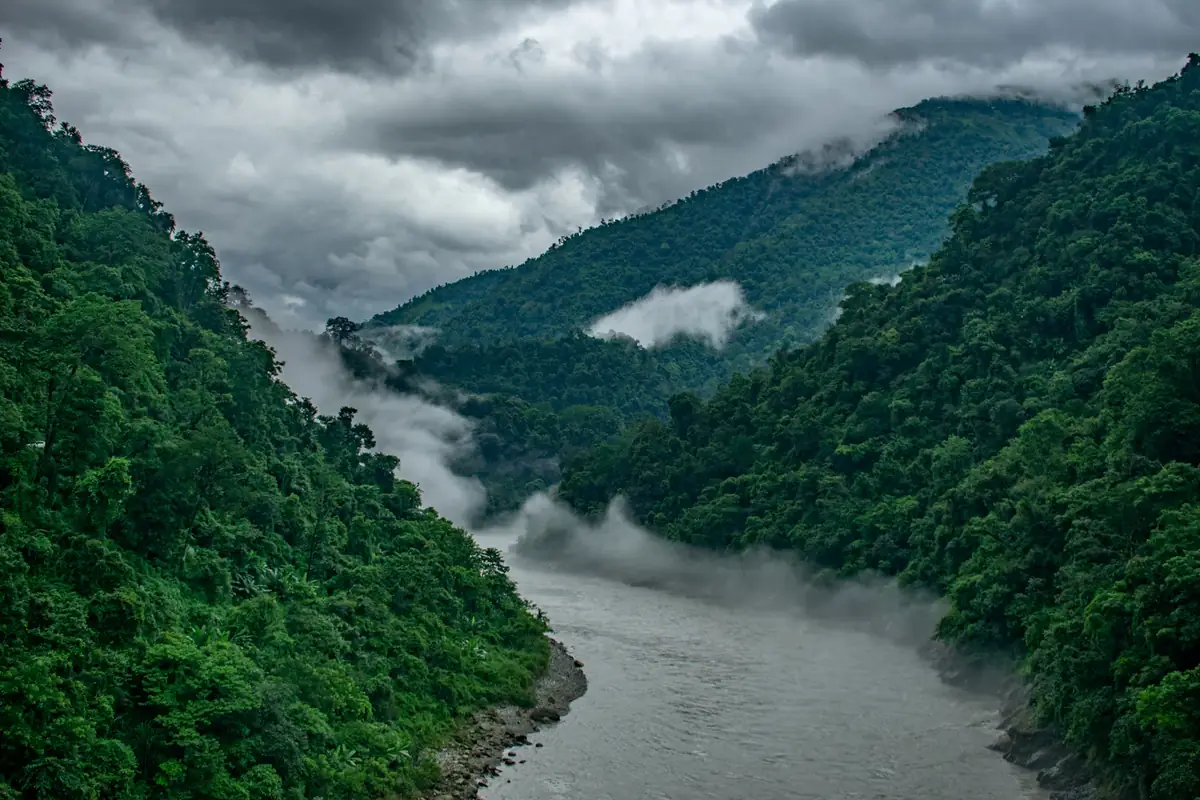
The Coronation Bridge carries the highway east from Sevoke across the Teesta, where the river runs through a deep gorge. Built between 1937 and 1941 and named for the coronation of King George VI, it is a single reinforced-concrete arch anchored in the rock of both banks. Locals call it Baghpool, the tiger bridge, after the tiger statues at one end.
History and design
The British wanted a reliable road link across the Teesta for goods and military supplies, but the river here runs deep and fast through a gorge, and swells sharply in the monsoon. Piers in the riverbed were not practical, so the engineers chose a fixed arch springing from rock on each bank.
The foundation stone was laid in 1937 by Sir John Anderson, then Governor of Bengal, the year of the coronation of George VI and Queen Elizabeth, after which the bridge is named. The design was led by John Chambers, the last British executive engineer of the Darjeeling Public Works Department, with three architects from Bengal, A. C. Dutt, S. K. Ghosh and K. P. Roy, working under him. J. C. Gammon of Bombay built it, and it was finished in 1941.
It is a spandrel-arch bridge about 22.8 m wide, rising about 39.6 m, with a longest span of about 81.7 m. Wikipedia gives its cost as ₹6 lakh; another official tourism page gives a different figure, so treat the cost as uncertain. It was designed to last a hundred years.
The bridge today
The bridge is part of National Highway 17 (formerly NH 31), the main road from Siliguri to the Dooars and on towards Assam; NH 10 to Kalimpong and Sikkim branches off nearby at Sevoke. It joins Darjeeling district at Sevoke with the far bank of the Teesta.
Age and heavy traffic have taken a toll. The 2011 earthquake damaged it and the state public works department carried out repairs; in 2020 engineers from Jadavpur University found a crack in the arch, and vehicles over 10 tonnes were restricted. It is now maintained by NHAI. A new bridge across the Teesta was approved in January 2025 to take the pressure off, and NHAI took over the project in March 2025.
Visiting Sevoke
Most people see the bridge on the drive from Siliguri to the Dooars. The Ministry of Tourism describes it as a place for views of the hills at sunrise and sunset, and notes a Coronation Bridge festival with illuminations; check locally for dates. Close by is the Sevokeshwari Kali Mandir, a popular stop for travellers, and about 2 km away the Sevoke railway bridge crosses the same river. The bridge carries highway traffic, so take photographs from the roadside rather than stopping on the deck.
Bagdogra (IXB), about 29 km from Sevoke, is the nearest airport; New Jalpaiguri (NJP) and Siliguri Junction are the nearest main stations.
Coronation Bridge: questions
Why is it called the Coronation Bridge?
It commemorates the coronation of King George VI and Queen Elizabeth in 1937, the year its foundation stone was laid.
Why is the Coronation Bridge called Baghpool?
Baghpool means tiger bridge. The name comes from the tiger statues at one end of the bridge.
When was the Coronation Bridge built?
Construction began in 1937 and was completed in 1941.
Which river does the Coronation Bridge cross?
The Teesta, at Sevoke, where the river comes out of the hills through a gorge.