Updated
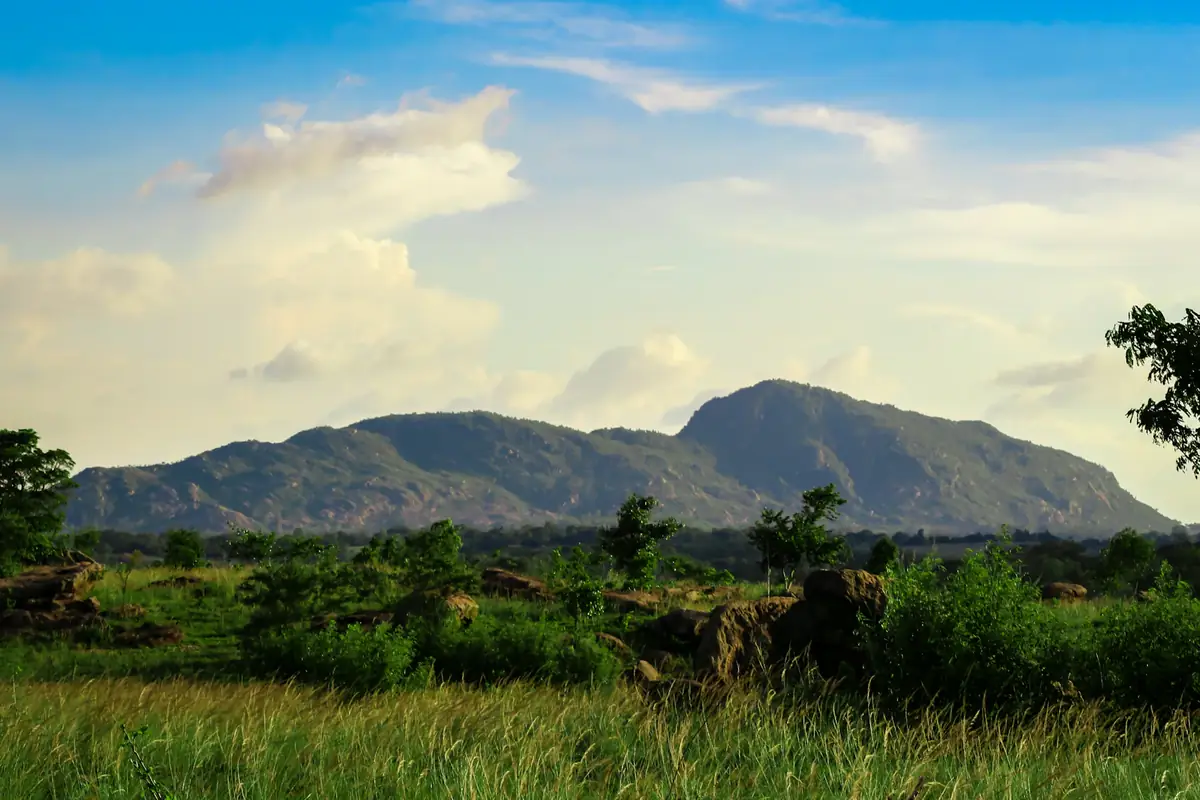
Deulghata is a riverside village in Arsha block of Purulia, known for its tall, curved brick temple towers (deuls) on the bank of the Kangsabati, dated by different scholars to between the 9th and 12th centuries. Only two or three of a once much larger group survive, rising out of scrub and sal woods, and the stucco ornament on their walls is still visible. The site lies about 25 km from Purulia town, between the town and the Ajodhya Hills.
Things to do in Deulghata
The brick deuls
Two tall rekha-style towers of brick, their curved spires still carrying stucco decoration of miniature temples, chaitya arches, geese and foliage.
Corbelled entrances
Each surviving temple has a triangular doorway made by stepping bricks inwards, a technique used before true arches.
Stone images
Sculptures recovered from the ruins, including an eight-armed Durga slaying Mahishasura, a Ganesha and Shiva lingas, are kept in a small temple nearby.
The Kangsabati
The river, also called the Kasai, runs beside the site, with sandbanks and sal woods along its banks.
Festivals
The quiet site fills with people at Dol Jatra in spring and at Tusu in mid-January.
History of the Deulghata temples
The temples' date is debated. Many accounts place them around the 9th–10th century; others argue for the 11th–12th century. Their decoration of stucco motifs, chaitya windows and miniature rekha towers is linked to the art of the Pala and Sena periods. Local tradition once attributed them to Jains, a strong presence in medieval Purulia, but the images recovered here are Hindu, pointing to a large Shaiva and Shakta centre.
When E. T. Dalton, Commissioner of Chota Nagpur, came here in 1864–65, he found three large temples standing among the ruins of many more; J. D. Beglar of the Archaeological Survey reported the same three in 1872–73. Accounts of how many once stood vary, from four large deuls to about fifteen temples with smaller shrines.
Today the count is disputed too: the Archaeological Survey of India has taken charge of the site, which is described as having two or three tall towers, and one of the three brick temples is reported to have collapsed in 2002. Treat the site gently; the brickwork is fragile.
What to look for
The towers follow the rekha deul form, with a square sanctum and a tall, gently curving spire, the same form found in Odisha's early temples but here built in brick rather than stone. Look closely at the upper walls for the stucco ornament and at the stepped, corbelled doorways. Several fallen temples were of stone, and the stone images collected from them show how rich the site once was.
How to reach Deulghata
By road. Deulghata lies near Baram, about 6 km south of Jaipur and roughly 25–30 km from Purulia town. A hired car from Purulia is the practical way, and it is easy to continue to the Ajodhya Hills, about 15 km to the south.
By train. Purulia Junction is the nearest major station, with direct trains from Howrah; check current timings with Indian Railways.
Deulghata: travel questions
What is Deulghata famous for?
Deulghata is a riverside village in Arsha block of Purulia, known for its tall, curved brick temple towers (deuls) on the bank of the Kangsabati, dated by different scholars to between the 9th and 12th centuries. Only two or three of a once much larger group survive, rising out of scrub and sal woods, and the stucco ornament on their walls is still visible.
What is the best time to visit Deulghata?
The best time to visit Deulghata is November to March.
How far is Deulghata from Kolkata?
Deulghata is about 285 km from Kolkata by road, about 7 hours by car depending on traffic.
How do I reach Deulghata?
By air: the nearest airport is Netaji Subhas Chandra Bose International Airport (CCU), Kolkata, about 6 hours by road. By train: Purulia Junction. By road: about 285 km from Kolkata.
What are the places to visit near Deulghata?
Places near Deulghata include Ajodhya Hills (about 10 km), Murguma (about 11 km), Charida (about 20 km) and Purulia (about 25 km). Distances are in a straight line.
How old are the Deulghata temples?
Their date is debated: most accounts say about the 9th–10th century CE, while others suggest the 11th–12th century.
How many temples survive at Deulghata?
Sources differ: two or three tall brick towers remain, out of a much larger group that once stood here.
Is Deulghata protected?
Yes. The Archaeological Survey of India has taken charge of the site.
Is Deulghata worth visiting?
Yes, if you are interested in early temple architecture: its brick rekha towers are rare survivors of the early medieval temples of the plateau. Expect a quiet riverside site with no facilities.